Troubleshooting
Each section describes a symptom, its usual causes and the fix. The issue numbers link to the original GitHub reports. If your problem isn’t covered, see the FAQ or open an issue and attach your logs.
On this page
Collect logs first
The log almost always shows what went wrong.
- Open Tools > View log (Ctrl+Shift+L) to watch the log live. Its Open Log Folder button opens the folder with all log files.
-
Or open the folder directly:
OS Log folder Windows %LOCALAPPDATA%\scoresight\scoresight\LogsmacOS ~/Library/Logs/scoresightLinux ~/.local/state/scoresight/log - Each session writes
scoresight_<date>_<time>.logandscoresight_std_<date>_<time>.log. Attach both files from the session with the problem to your issue. If ScoreSight closed by itself (a crash), the end of thescoresight_std_file shows where:Windows fatal exceptionorFatal Python error, followed by what each part of the program was doing at that moment.
Logs can contain host names and URLs (including any tokens in them). ScoreSight 0.1.x also logged the OBS WebSocket password; 0.2.0 doesn’t. Look through the logs and remove secrets before posting them publicly.
For even more detail, start ScoreSight with the environment variable SCORESIGHT_DEBUG=1 (see Environment variables).
Source problems
When a source can’t be opened or read, a red banner under the source bar says what failed and what to try, and the dot before the Source drop-down turns into a red square. Retry opens the same source again; Choose another source opens the list. An amber triangle means the source is opening, slow (less than half its own frame rate), stalled or reconnecting: its tooltip says which.
RTSP or URL stream won’t open (#10)
Symptoms: the banner says “Can’t open the stream …”, a black picture, or (in old versions) VIDEOIO(DSHOW): backend is generally available but can't be used to capture by name in the log (#10).
Fix:
- Make sure you run a current version. Versions before 0.0.12 tried to open URLs with DirectShow on Windows, which can never work.
- Test the exact URL in VLC (Media > Open Network Stream). If VLC can’t play it, fix the URL, the credentials or the network first.
- Include user, password, port and path:
rtsp://user:password@192.168.1.50:554/stream1. URL-encode special characters in the password. - Check the RTSP transport. ScoreSight tries RTSP over TCP first, which works across VPNs, Wi-Fi and NAT, and falls back to UDP when the camera refuses TCP. If your camera only supports UDP and the stream still won’t open, set
OPENCV_FFMPEG_CAPTURE_OPTIONS=rtsp_transport;udpbefore starting ScoreSight to force UDP. See RTSP over TCP. - Try the camera’s sub stream (lower resolution).
- Fallback: open the stream in OBS and send it to ScoreSight with NDI or OBS’s Virtual Camera.
ScoreSight 0.2.0 gives up opening or reading a stream after 5 seconds, so a dead stream no longer freezes the window or makes switching sources hang.
Camera not listed or black picture
- Click Reload sources (⟳, or F5) after plugging in a camera.
- Close other apps that use the camera (OBS, Zoom, Teams, the camera vendor’s software). Most cameras serve only one app at a time.
- macOS: allow Camera access in System Settings > Privacy & Security > Camera.
- Linux: add your user to the
videogroup and log in again. Cameras are listed as name (/dev/videoN); only device nodes that can capture video are shown. - Open Video settings (the gear next to the source) and try another Capture Backend or Video Format (
MJPGvsYUY2). - Capture cards: make sure the input signal is present (a resolution and frame rate the card supports), and try it in the vendor’s own software.
NDI source not listed
- Click Reload sources (⟳, or F5). Sources that start after ScoreSight appear only after a reload.
- Make sure both computers are on the same network and subnet, and that the firewall allows NDI.
- macOS: allow Local Network access for ScoreSight in System Settings > Privacy & Security.
Screen capture shows nothing
- macOS: allow Screen Recording (System Settings > Privacy & Security > Screen & System Audio Recording), then quit and restart ScoreSight. Without the permission, the source banner says so, and its Open System Settings button opens the page.
- Linux: screen capture isn’t supported. Use OBS with NDI or the virtual camera.
- Minimized windows can’t be captured. Keep the window visible and at a fixed size.
Slow start
Every start logs how long it took, one line per session that begins with Startup: in scoresight_<date>_<time>.log (see Collect logs first), for example:
Startup: before main.py 0.20 s, arguments 0.00 s, imports 0.35 s, QApplication 0.00 s, main window 0.03 s, show 0.00 s, first event loop pass 0.01 s; total 0.59 s; HTTP server ready at 0.57 s, video sources discovered at 0.62 s
- before main.py: from launching the app until its Python code runs (unpacking and loading the app, which antivirus scanning or a slow disk can make long).
- imports, QApplication, main window, show, first event loop pass: the steps that build the window.
- total: from launching the app until its window is ready.
- HTTP server ready and video sources discovered happen in the background and don’t hold the window up. A slow camera or NDI discovery shows here; if it took longer than about 5 seconds, it has a
Startup:line of its own.
If ScoreSight is slow to start, open an issue with the Startup: line (or the whole log) of a slow start, your OS and its version, how you installed ScoreSight (installer, portable zip, disk image, from source) and whether a second start right after the first is also slow.
macOS: slow start, freezes, or hang when quitting (#33, #7)
Symptoms: in ScoreSight 0.1.x and older on macOS, the app took up to a minute to appear (#33), the window froze (“beach ball”) for long periods, or it showed “Not Responding” when quitting and had to be force-quit (#7).
Causes and fixes in 0.2.0:
- The slow start came from the packaging: the 0.1.x macOS app unpacked itself into a temporary folder on every launch. The 0.2.0 app is a regular app bundle that starts in seconds. Finding cameras and NDI sources and connecting to OBS also happen in the background now, so the window appears right away.
- The quit hang came from the built-in HTTP server, which didn’t shut down cleanly on macOS. ScoreSight 0.2.0 stops it internally, so quitting is immediate.
- Freezes during use came from network outputs (OBS, vMix, UNO) waiting for slow or unreachable targets on the main thread. In 0.2.0, all outputs run in the background with timeouts.
- Closing or switching away from a stalled source waits at most 3 seconds.
- macOS App Nap no longer slows ScoreSight down while its window is in the background.
If you still see it:
- Update to the latest release.
- For a slow start, look at the
Startup:line in the log (see Slow start). - Turn off outputs whose target is offline (stop vMix/UNO, disconnect OBS).
- Collect the logs and, for hangs, a sample from Activity Monitor (select ScoreSight > the “…” menu > Sample Process), and open an issue.
Force-quitting doesn’t damage your settings: they are saved as you work.
Output problems
vMix shows no data (#55, #25)
Symptom: vMix titles don’t change. ScoreSight 0.1.x logged Failed to send data to http://localhost:8099/api/... BadStatusLine('VERSION OK ...'). ScoreSight 0.2.0 shows ■ Port 8099 is vMix’s TCP API: use 8088 in the vMix row of the Outputs list and logs vMix: VMixTCPPortError: localhost:8099 answered like the vMix TCP API ('VERSION OK') (#55, #25).
Cause: port 8099 is vMix’s TCP API. ScoreSight uses vMix’s HTTP Web API, which listens on port 8088.
Fix:
- In vMix, enable Settings > Web Controller (port 8088).
- In ScoreSight, select vMix in the Outputs list, set the port to 8088 and press Enter. ScoreSight 0.2.0 changes a saved 8099 to 8088 automatically the first time it starts.
- Use the exact field names from the vMix Title Editor, including
.Text(for exampleHome Score.Text). - Check the Input number, and click Start.
Full guide: vMix.
OBS text doesn’t update (#30)
- Look at the OBS row of the Outputs list: it says whether ScoreSight is connected, and why not (see OBS: Troubleshooting).
- In ScoreSight 0.1.x, OBS updates only worked when an output folder was set in the Text Files tab. 0.2.0 removed that requirement. Update, or set a folder as a workaround.
- The OBS text sources must be named exactly
Home score,Away score,Clock,Period,#Home Fouls,#Away Foulsorshotclock, or use Create OBS Scene. Custom fields don’t update OBS by default (see OBS: Custom fields). A wrong name shows up in the log asOBS: OBSSDKRequestError: Request SetInputSettings returned code 600. - If updates stop after a few minutes (#30), check whether OBS restarted or the WebSocket dropped. ScoreSight 0.2.0 reconnects by itself (the log shows
OBS: OBSConnectionLost: ...while OBS is unreachable, thenOBS: reconnected to <host>:<port>). On 0.1.x, reconnect with Connect OBS. A Browser Source overlay is a robust alternative. - On macOS, prevent your Mac from sleeping during a stream. ScoreSight 0.2.0 turns off App Nap for itself, so it keeps full speed while its window is hidden.
Text files are not written (#6)
Symptom: results.csv and results.xml appear, but no <Box Name>.txt files (#6).
Cause (0.1.x): .txt files were written only at the exact moment a value changed. If that moment fell between two file saves, the file wasn’t written until the next change.
Fix: ScoreSight 0.2.0 writes each file whenever its value differs from what it last wrote, or when the file is missing, and a value that changes between two saves is written at the next save. If files are still missing:
- Check that an output folder is set and still exists (ScoreSight forgets a folder that was deleted, and logs
Output folder does not exist). - Check that the box’s reading is green or light green. Rejected (yellow) and empty readings aren’t written.
- Look for
Error writing to <path>in the log (permissions, a full disk, or a folder synced by OneDrive/Dropbox). - Box names with characters that aren’t allowed in file names are written with
_instead, for exampleHome_Away.txtfor Home/Away.
CSV doesn’t update in real time (#29)
In ScoreSight 0.2.0, results.csv is updated atomically with the current values (header once, values properly quoted). For a live data file, use Don’t append results, or read http://localhost:18099/csv?pivot from the HTTP server. For a game log, use Results in .csv file: a row is added whenever a value changes, and when you add, remove or rename a box, the old log is kept as results-<timestamp>.csv and a new file is started. See Text, CSV & XML Files and #29.
HTTP server not reachable
- Port 18099 is already in use: the log shows
HTTP server: port 18099 is already in use or not available. Another ScoreSight instance (or another program) uses the port, and this instance runs without its HTTP server. Close the other program, or start this instance with--port 18100(see profiles). - Works in a browser but not in PowerShell or a script: the server listens on IPv4 only. Use
http://127.0.0.1:18099instead oflocalhost. - From another computer: use the ScoreSight computer’s IP address and allow ScoreSight through its firewall.
Recognition problems
Wrong or unstable readings (#30)
Readings come from the picture, so start there (#30 is a good example of a low-contrast stadium board):
- Look at the box in Binary View. Digits must be solid and clearly separated from the background.
- Crop to the scoreboard and use 4-corner for angled cameras.
- Set Binarize to Local or Adaptive for low-contrast boards or dark surroundings.
- Set the Type and a strict Format so impossible values are rejected.
- Use Remove leading 0s for zero-padded scores, and consider one box per digit for very poor boards.
- Try another OCR model (under All boxes, in the Box tab).
The full method is in Recognition Tuning.
Readings are yellow even though they look right
The reading failed the box’s Format (the raw text didn’t fully match) or the Conf. Th confidence threshold. Check the format (for example Period 1-4 rejects an overtime period 5: choose Period d). The confidence threshold is off (0) by default; if you raised it, lower it or set it back to 0. With Tesseract, correct readings of real scoreboards often have a confidence of only 30–50 %; with PP-OCR, 80–90 % is a good threshold. See Conf. Th.
Digits appear on a blank box
ScoreSight 0.1.x could read digits on an empty area, such as an unlit digit position. ScoreSight 0.2.0 doesn’t run the OCR on a blank image, so such a box reads as empty (∅). If you still see invented digits, the area isn’t really blank in Binary View: try another Binarize method or raise Cleanup.
Performance problems
Low Frames/s, Updates/s or Previews/s (#20)
(#20)
- Previews/s ≈ 1 is by design: the preview refreshes once per second to save CPU. It doesn’t affect readings.
- Updates/s follows the Detections / s slider (default 5, maximum 15). Raise the slider if you need more.
- Frames/s is capped at about 33. Lower values mean the source delivers fewer frames or the CPU is busy with OCR. Reduce the number of boxes, crop the picture, enable Skip Similar Image, and lower the camera resolution.
See Performance Tuning.
Video freezes when Detections / s is at 1 (#53)
In ScoreSight 0.1.x, setting Detections / s to 1 stopped all processing, and the UI could stay disabled after a restart (#53). This is fixed in 0.2.0: the first frame is shown and read right away, and the preview refreshes about once a second at any detection rate. On older versions, set the slider to 2 or higher.
The window is slow or freezes when a vMix/UNO/API target is offline
Fixed in 0.2.0: outputs send in the background with timeouts. On older versions, stop vMix/UNO and disable the API output when the target is offline.
Other problems
OCR training data goes to the wrong folder (#52)
In 0.1.x, a changed Save Folder in OCR Training Data Setup was ignored (#52). This is fixed in 0.2.0: the chosen folder is used and remembered. See OCR Training Data.
The interface is too light or hard to read (#50)
Use View > Appearance to choose Dark, Light or System (follow the operating system) (#50). The choice is remembered.
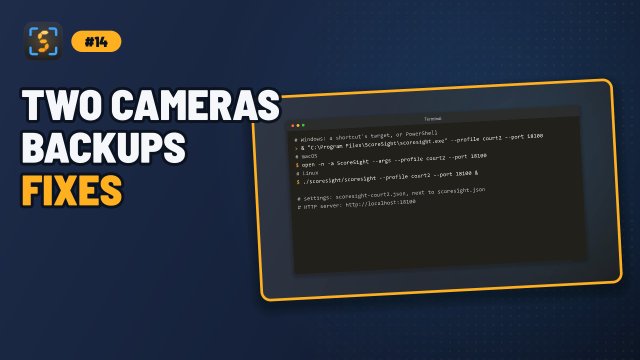
Two cameras at once (#8)
Run two instances with different profiles and ports, for example --profile shotclock --port 18100. See Multiple Instances & Profiles and #8.
Antivirus or SmartScreen warnings (Windows)
Antivirus heuristics sometimes flag PyInstaller apps as false positives, especially unsigned ones (releases before 0.3.2, after which the installer and the app are code-signed by Roy Shilkrot) and new releases. Download only from the Releases page and verify the checksum. Then allow that specific file (don’t disable your antivirus), and report the false positive to your antivirus vendor. See Installation.
Linux: “Could not load the Qt platform plugin xcb”
Packages older than 0.2.0 may not include libxcb-cursor0 and the other xcb libraries Qt needs (0.2.0 includes them). Update ScoreSight, or install the X11/xcb runtime libraries, for example on Debian/Ubuntu sudo apt install libxcb-cursor0 libxkbcommon-x11-0 libegl1.
Start over with clean settings
- Optionally use File > Export field layout… to keep your boxes.
- Quit ScoreSight.
- In the settings folder, rename
scoresight.json(orscoresight-<profile>.jsonfor a profile), for example toscoresight.json.old. Don’t delete the folder: it also holds your other profiles and, in its default locationocr_training_data/, your OCR training data. - Start ScoreSight. It starts with defaults.
Still stuck?
Ask in Q&A, in ScoreSight’s Discussions: other users and the developers answer there (in the app: Feedback, at the right end of the status bar). If it looks like a bug, open an issue. The bug report form asks for your version, OS, source type, outputs and logs, which is everything needed to help you.